Geoffrey Hinton, often referred to as the “Godfather of Deep Learning,” is a British-Canadian cognitive psychologist and computer scientist. He is well-known in the industry for his pioneering work in artificial intelligence, particularly neural networks. Geoffery has made foundational contributions to the development of deep learning, a subset of machine learning that has driven many recent advances in AI.
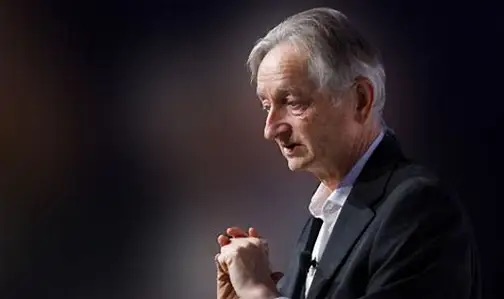
Hinton’s notable contributions include co-authoring a highly influential paper in 1986 that popularized the backpropagation algorithm for training multi-layer neural networks¹. This work laid the foundation for many modern AI applications. He has also been instrumental in developing other key AI concepts, such as Boltzmann machines and capsule neural networks¹.
Geoffrey Hinton, often referred to as the “godfather of AI,” has been awarded the 2024 Nobel Prize in Physics. He shares this prestigious honor with John J. Hopfield of Princeton University. Their groundbreaking work has significantly advanced the field of machine learning and artificial neural networks¹².
Hinton’s contributions include the development of the Boltzmann machine, a type of neural network that can learn to recognize patterns in data and generate new examples based on those patterns. This technology underpins many modern AI applications, from large language models like ChatGPT to self-driving cars⁴⁵.
Hinton expressed his surprise and honor at receiving the award, highlighting the unexpected nature of this recognition⁵. His work, along with Hopfield’s, has had a profound impact on both physics and artificial intelligence, demonstrating the interdisciplinary nature of their discoveries³.
Isn’t it fascinating how AI research is being recognized at such a high level?
(1) Geoffrey Hinton from University of Toronto awarded Nobel Prize in Physics. https://www.msn.com/en-ca/news/other/geoffrey-hinton-from-university-of-toronto-awarded-nobel-prize-in-physics/ar-AA1rT3IN.
(2) Nobel Prize in Physics awarded to AI pioneers John Hopfield, Geoffrey Hinton. https://www.msn.com/en-us/news/world/nobel-prize-in-physics-awarded-to-ai-pioneers-john-hopfield-geoffrey-hinton/ar-AA1rWE2g.
(3) Geoffrey Hinton – Facts – 2024 – NobelPrize.org. https://www.nobelprize.org/prizes/physics/2024/hinton/facts/.
(4) Geoffrey Hinton wins Nobel Prize in Physics | University of Toronto. https://www.utoronto.ca/news/geoffrey-hinton-wins-nobel-prize.
(5) The Godfather of AI: Nobel Prize in Physics awarded to Geoffrey Hinton. https://www.openaccessgovernment.org/the-godfather-of-ai-nobel-prize-in-physics-awarded-to-geoffrey-hinton/183760/.
(6) Geoffrey Hinton Awarded the 2024 Nobel Prize in Physics. https://www.acm.org/articles/bulletins/2024/october/geoffrey-hinton-nobel-prize.
Throughout his career, Hinton has held positions at several prestigious institutions, including the University of Toronto and Google Brain¹. In 2017, he co-founded the Vector Institute in Toronto, where he continues to serve as Chief Scientific Advisor¹. His contributions to AI have been recognized with numerous awards, including the 2018 Turing Award, which he shared with Yoshua Bengio and Yann LeCun¹.
In 2024, Hinton was awarded the Nobel Prize in Physics for his foundational discoveries and inventions that enable machine learning with artificial neural networks². Despite his achievements, Hinton has also expressed concerns about the risks associated with AI technology, leading to his departure from Google in 2023¹.
Is there a specific aspect of Hinton’s work or life that interests you the most?
Source: Conversation with Copilot, 10/10/2024
(1) Geoffrey Hinton – Wikipedia. https://en.wikipedia.org/wiki/Geoffrey_Hinton.
(2) Geoffrey Hinton | Biography, Education, & Facts | Britannica. https://www.britannica.com/biography/Geoffrey-Hinton.
(3) Geoffrey Hinton – Facts – 2024 – NobelPrize.org. https://www.nobelprize.org/prizes/physics/2024/hinton/facts/.
(4) ジェフリー・ヒントン – Wikipedia. https://ja.wikipedia.org/wiki/%E3%82%B8%E3%82%A7%E3%83%95%E3%83%AA%E3%83%BC%E3%83%BB%E3%83%92%E3%83%B3%E3%83%88%E3%83%B3.
Key Contributions:
- Backpropagation: One of Hinton’s most significant contributions to AI is the development and popularization of the backpropagation algorithm, which is used to train deep neural networks. Backpropagation allows neural networks to adjust their weights iteratively, improving their accuracy in tasks like image recognition, speech processing, and more.
- Deep Belief Networks (DBNs): Along with his students, Hinton introduced deep belief networks, a type of neural network that models data in layers and can efficiently learn representations from data. This work was crucial in sparking the resurgence of interest in deep learning in the early 2000s.
- Breakthrough in Image Recognition: Hinton’s team won the ImageNet competition in 2012, a significant AI benchmark, using convolutional neural networks (CNNs). Their results demonstrated that deep learning models could vastly outperform traditional methods in visual recognition tasks, which accelerated the adoption of deep learning in industry and research.
- Work at Google: Hinton has been a key figure at Google, where he worked to apply deep learning to various AI challenges, including natural language processing, voice recognition, and image search. In 2013, Google acquired DNNresearch, a company Hinton co-founded, further integrating his research into their AI efforts.
- Capsule Networks: More recently, Hinton has worked on capsule networks, a new kind of neural network designed to overcome some limitations of conventional deep learning architectures, especially in terms of representing spatial relationships in data.
Academic Career:
Hinton has held positions at several prestigious institutions, including Carnegie Mellon University, the University of Toronto, and University College London (UCL). At the University of Toronto, he co-founded the Vector Institute, a leading AI research hub in Canada. His students and collaborators include many of the leading figures in AI today, including Yann LeCun and Ilya Sutskever.
Awards and Honors:
- In 2018, Hinton, along with Yann LeCun and Yoshua Bengio, won the prestigious Turing Award, often considered the “Nobel Prize of Computing,” for their work on neural networks and deep learning.
- He has been recognized by numerous scientific and industry bodies for his transformative contributions to AI.
Recent Perspectives:
In recent years, Hinton has expressed both excitement and caution about the rapid progress in AI. He has spoken about the potential risks of AI technologies, especially as they become more powerful and ubiquitous. In 2023, Hinton made headlines when he resigned from Google to speak more freely about the potential dangers of artificial intelligence, especially concerning its societal impact and ethical implications.
Hinton remains one of the most influential voices in the AI field, continually shaping discussions on the future of artificial intelligence and its broader implications.
 The Artificial Intelligence News Source
Leave a comment